
Disconnected systems are costing your business time, data, and revenue. You need your tools and systems to “talk” to each other. At Providus, we deliver end-to-end Salesforce integration services that connect your CRM to every tool in your stack.
Choose an option to see how Providus solves your unique challenge:







Your reps are switching between Salesforce, your ERP, your billing system, and multiple spreadsheets just to get a complete picture of one account. Every system holds a piece of the data. None of them talks to each other.
When the same customer record exists in four different systems with four different field values, nobody knows which one is right. If you can’t trust your data, you need to rethink your CRM strategy.
Point-to-point connections between Salesforce and your other tools were never built to scale. Every time one system updates, something else breaks. Every hour of downtime means your business is running on incomplete, unreliable data.
When Salesforce is connected to your ERP, marketing platform, support tools, and billing system, every team works from the same accurate, up-to-date customer record.
We build cross-system automation using Salesforce Flow, Platform Events, and custom Apex so that when something happens in one system, the right action triggers automatically in every other connected system
When your systems sync automatically through properly built Salesforce integrations, duplicate records disappear, field values stay consistent, and your reports reflect what is actually happening in your business right now.
We build Salesforce integrations using proven architecture patterns, including REST APIs, SOAP APIs, MuleSoft, and event-driven design. Our team ensures your integrations handle growing data volumes, new system additions, and platform updates flawlessly.
We configure real-time data sync between Salesforce and your connected systems. Hence, your sales reps, marketing teams, and ops leaders always have current, accurate information pulled from every system in your stack without any manual refresh or update.
The right Salesforce integration architecture works wonders for your CRM’s functionality and connectivity needs. We design your integration layer with scalability in mind. Adding a new tool, expanding into a new vertical, or migrating a system saves the hassle of building everything from scratch.
Before we connect a single system, we understand your business first. Our Salesforce integration consultants assess your current tech stack, identify where data is breaking down, and design an integration architecture that solves the right problems based on your priorities.
What’s included:
When standard connectors and pre-built tools don’t fit your requirements, we build what does. Our certified developers specialize in Apex coding, configuring Platform Events, and designing custom REST and SOAP API integrations. We ensure your Salesforce org connects to every tool and system across your stack.
What’s included:
Every poorly executed integration exposes gaps in how your Salesforce org is configured. We customize your org, including objects, page layouts, fields, and validation rules, to ensure the data coming in through your integrations is in the right place, in the right format, and usable.
What’s included:
Sometimes, an integration reveals that the underlying foundation of your Salesforce org is faulty and needs to be rebuilt before it can connect reliably to anything else. Our certified implementation experts assess your current setup, fix what’s broken, and build the right foundation for your CRM where integrations are well-configured and run stably.
What’s included:
When moving to Salesforce from another CRM, you need to migrate your integrations as well, along with your data. We audit your existing data, map every field to the correct Salesforce object, and build the integration connections your new org needs.
What’s included:
Your integrations need ongoing attention as your business grows and your tech stack evolves. Our managed services give you a dedicated Salesforce integration team monitoring your connected systems, catching errors before they affect your data, and updating your integrations when platforms release new API versions.
What’s included:
When an integration breaks, your data stops flowing, and your team stops moving. Our support and maintenance service gives you direct access to Salesforce integration specialists who diagnose connection failures fast, identify the root cause, and restore data flow without disrupting your operations.
What’s included:
We help companies simplify their processes and scale their operations by providing Salesforce development services across the platform ecosystem.
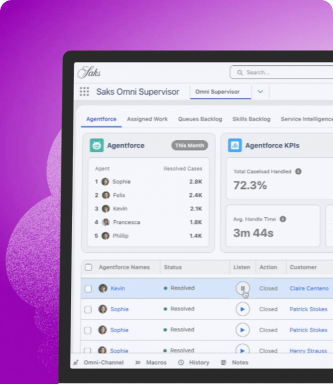
We integrate Agentforce with your external systems so your AI agents have access to real-time data from every connected platform. From feeding live ERP and support data into agent actions to configuring external API callouts that trigger automated responses, we build the data connections that make your Agentforce deployment actually intelligent.
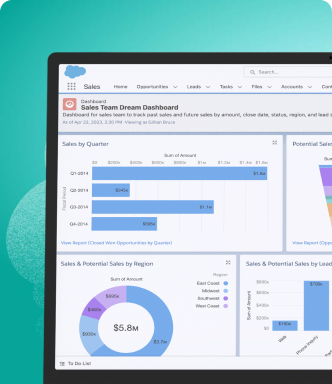
We integrate Sales Cloud with your ERP, CPQ, billing systems, and marketing platforms so your sales team has a complete, real-time view of every account without leaving Salesforce. Pipeline data, order status, payment history, and campaign engagement all flow into one place. Your reps should be able to focus more on selling instead of switching between systems.
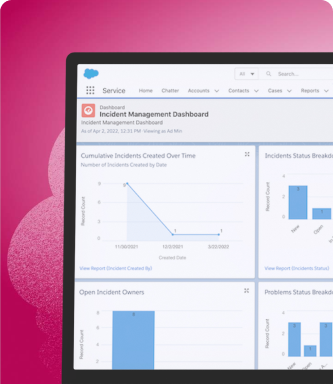
We integrate Service Cloud with your ITSM tools, customer portals, telephony systems, and knowledge bases so your support team has the full customer context they need the moment a case opens. Every interaction, order, and account detail flows into Salesforce automatically.
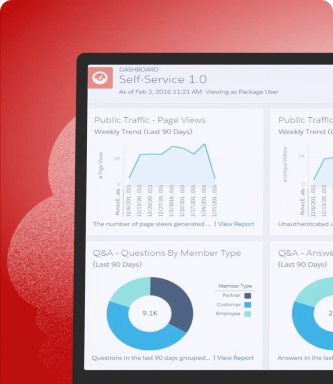
We integrate Marketing Cloud directly with your CRM data, ecommerce platforms, and analytics tools so your marketing team builds campaigns on accurate, real-time audience data. Lead scores, purchase history, support interactions, and engagement signals all flow into Marketing Cloud automatically.
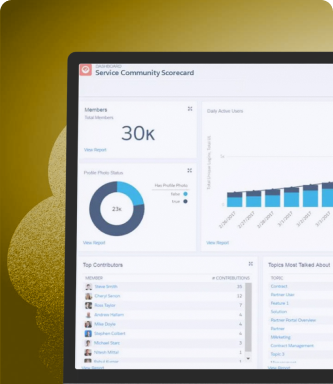
We integrate Experience Cloud portals with your back-end Salesforce data, external databases, and third-party platforms so your customers, partners, and internal users always see accurate, live information. Every data point your portal surfaces comes directly from your connected systems.
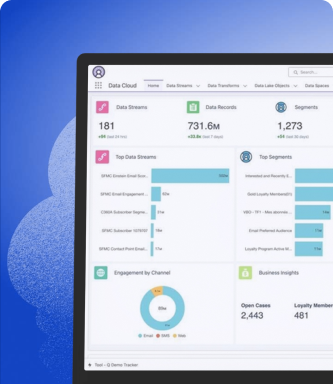
We implement and integrate Salesforce Data Cloud to unify customer data from every source in your business, including CRM, marketing, commerce, support, and external databases, into a single real-time customer profile. Clean Salesforce data integration enables smarter segmentation, more accurate automation, and better decisions across your teams.
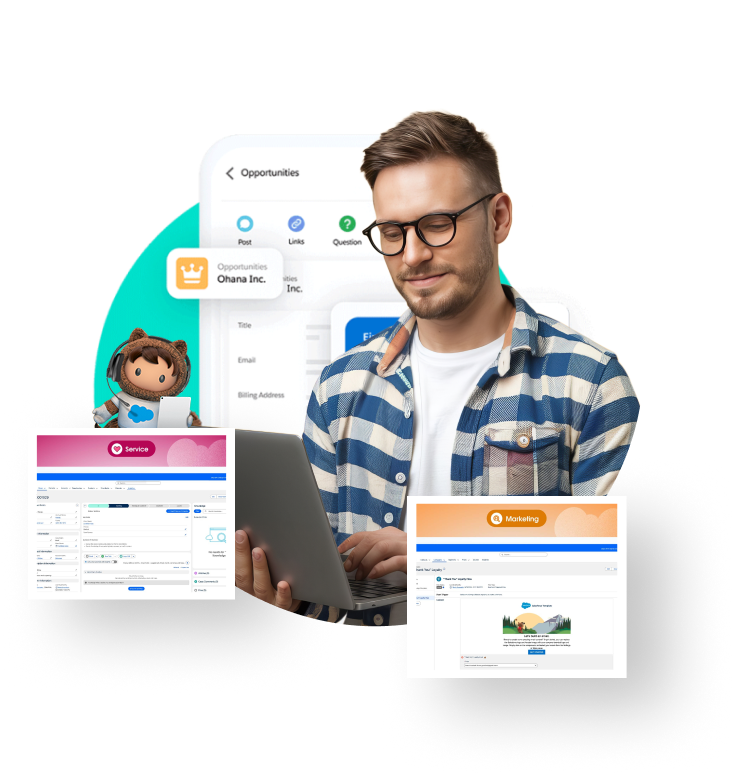
At Providus, our certified team owns your entire integration project from architecture design to post-go-live monitoring. We provide reliable support and promptly fix what’s broken.
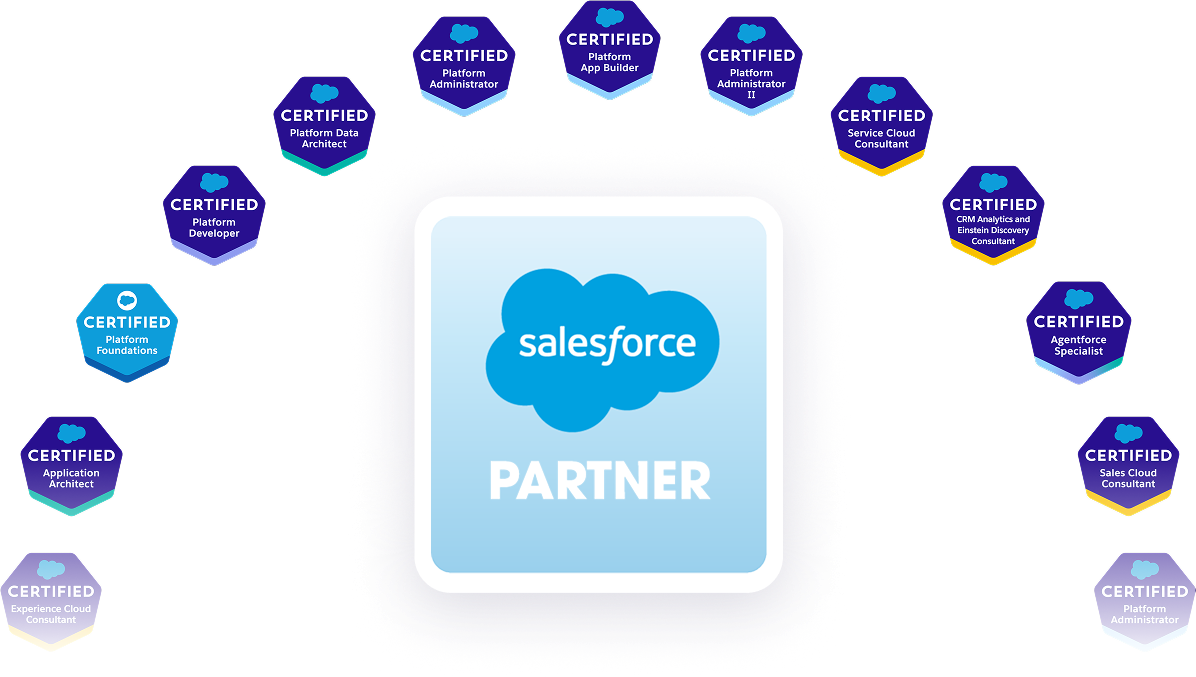
Our certified Salesforce integration consultants, developers, and architects have hands-on experience building complex integrations across REST APIs, SOAP APIs, MuleSoft, Platform Events, Change Data Capture, and Agentforce.
We build integrations into your CRM based on how your business actually operates. Before we write a single line of code or configure a single API connection, we map your data flows, understand your system dependencies, and define what a successful integration looks like.
We integrate Salesforce Nonprofit Cloud with donor management platforms, grant tracking systems, email marketing tools, and financial software so your team has a single, accurate view of every donor relationship, funding stream, and programme outcome.
We integrate Salesforce Commerce Cloud with your ERP, inventory management system, payment gateways, and marketing platforms so order data, customer behaviour, and product information flow cleanly between every system in real time.
We integrate Salesforce Health Cloud with EHR systems, patient engagement platforms, billing software, and care coordination tools so your clinical and administrative teams have a complete, HIPAA-compliant view of every patient relationship.
We integrate Salesforce Financial Services Cloud with your core banking systems, portfolio management platforms, compliance tools, and client communication software so your advisors and relationship managers have complete client visibility in one place.
We integrate Salesforce Education Cloud with your SIS, LMS, financial aid platforms, and communication tools so your admissions, student success, and alumni teams have a connected view of every student relationship.
We integrate Salesforce Manufacturing Cloud with your ERP, supply chain management systems, dealer portals, and demand planning tools so your sales and operations teams work from the same real-time data.



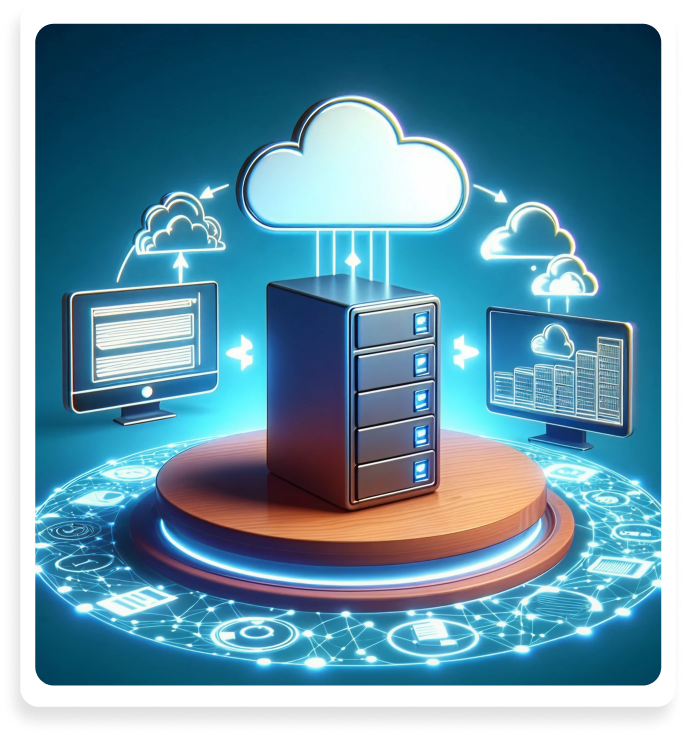
Salesforce integrations connect your CRM org with external systems like ERPs, payment gateways, marketing tools, or databases. The connection lets data flow both ways through APIs, middleware, or webhooks. Records stay in sync, so sales, service, and finance teams work from the same data.
You need a certified Salesforce Integration partner, especially when your systems run in silos, your team manually copies data between tools, or APIs fail under load. Other factors include duplicate records across platforms, broken middleware, missing audit trails, and slow reporting. At Providus, we assess your stack and design the right integration pattern. DIY integrations often skip error handling and security, which breaks in production within weeks.
Salesforce supports several integration methods:
Salesforce data integration syncs records between Salesforce and external systems like ERPs, billing tools, and data warehouses. Importantly, broken data flows cause duplicate accounts, stale opportunities, and missed revenue. Clean integration also keeps your single source of truth intact. Therefore, our consultants design sync rules, conflict handling, and error logging. As a result, data stays accurate across every platform you use.
We can integrate the following platforms and enterprise systems with Salesforce:
Real-time Salesforce integration syncs records the moment they change. Specifically, it uses REST APIs, webhooks, Platform Events, or Change Data Capture. Therefore, use it for order processing, payment confirmations, or service tickets where latency matters. Batch integration, on the other hand, moves data in scheduled jobs, usually overnight.
It also uses Bulk API or ETL tools and handles millions of records efficiently. As a result, batch suits analytics loads, payroll syncs, or reporting feeds where speed is not critical. In practice, our consultants often combine both in one architecture.
A Salesforce integration project timeline depends on the scope. For instance, simple point-to-point integrations finish in 2 to 4 weeks. Mid-sized projects with middleware and multiple endpoints also take 6 to 12 weeks. However, complex enterprise integrations across ERPs and finance systems run 3 to 9 months. Our team scopes the timeline after a discovery call.
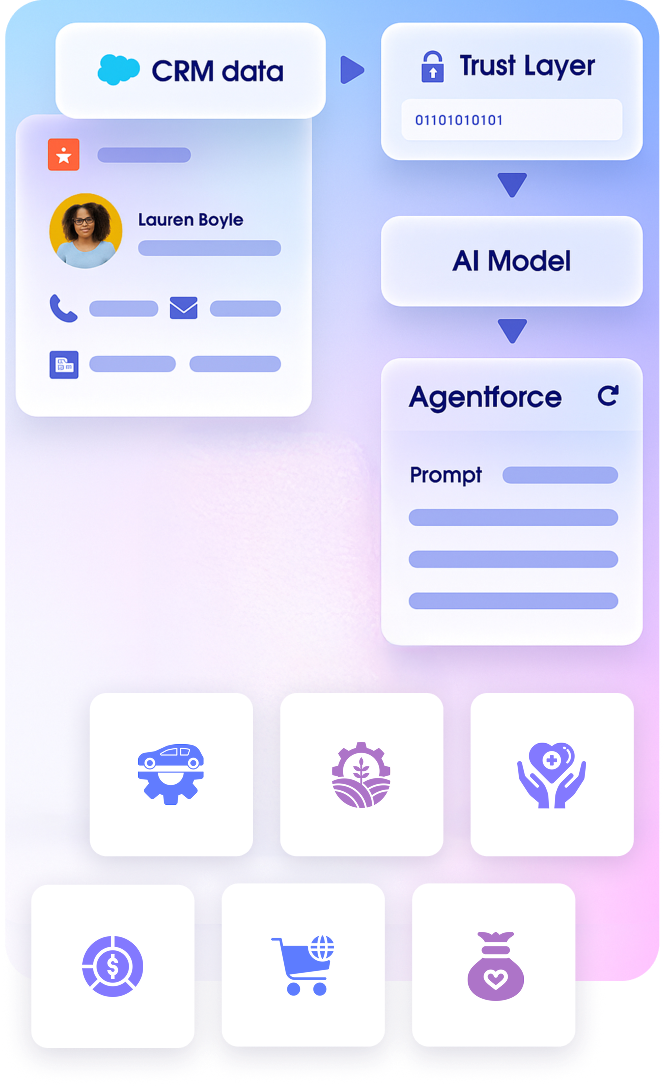
Agentforce integration starts when our consultants enable it in the setup and configure the Data Cloud. Next, our team defines agent topics and actions. We also connect agents to your existing objects, flows, and Apex through the Atlas Reasoning Engine. In addition, guardrails, prompt templates, and Einstein Trust Layer settings get applied. As a result, most rollouts go live in 4 to 8 weeks.
Salesforce integration support continues for 30 to 90 days after go-live. During ongoing support, our team monitors API limits and fixes sync errors. We also tune retry logic and adjust field mappings. After that, many clients move to monthly retainers covering release upgrades and new endpoints. Therefore, SLAs stay contract-based with documented response times.