
Why Automation is Essential for Nonprofits?

Contents:
Can your nonprofit really afford to lose valuable time on manual work when every donor dollar and volunteer hour matters? Research shows that charity teams spend nearly one-third of their workweek handling repetitive administrative tasks. That adds up to thousands of hours each year spent on paperwork instead of driving real impact.
Managing donor data, coordinating volunteers, and tracking results can quickly become overwhelming without the right systems in place. This is where nonprofit automation makes a real difference. Built on a unified platform like Salesforce Nonprofit Cloud, automation ensures that your resources are focused on creating change.
Besides that, there are several other key reasons why automation is essential for nonprofits everywhere. Read on to know more about this.
1. Nonprofits at a Breaking Point
Most of the nonprofits operate across regions, manage multiple programs, and handle large volumes of data. As operations expand, so do the challenges. Manual processes become slower, more error-prone, and difficult to scale.
Their tasks, like sending donor emails, updating spreadsheets, event registrations, and tracking contributions individually, look hard to manage. However, when combined, they create inefficiencies that drain time and energy.
Without proper systems in place, even the most passionate teams can struggle to maintain momentum. This is why embracing workflow automation is now non-negotiable for them. This is a critical time to consider Salesforce Nonprofit Cloud consulting to map out a scalable digital strategy.
2. Greater Process Efficiency
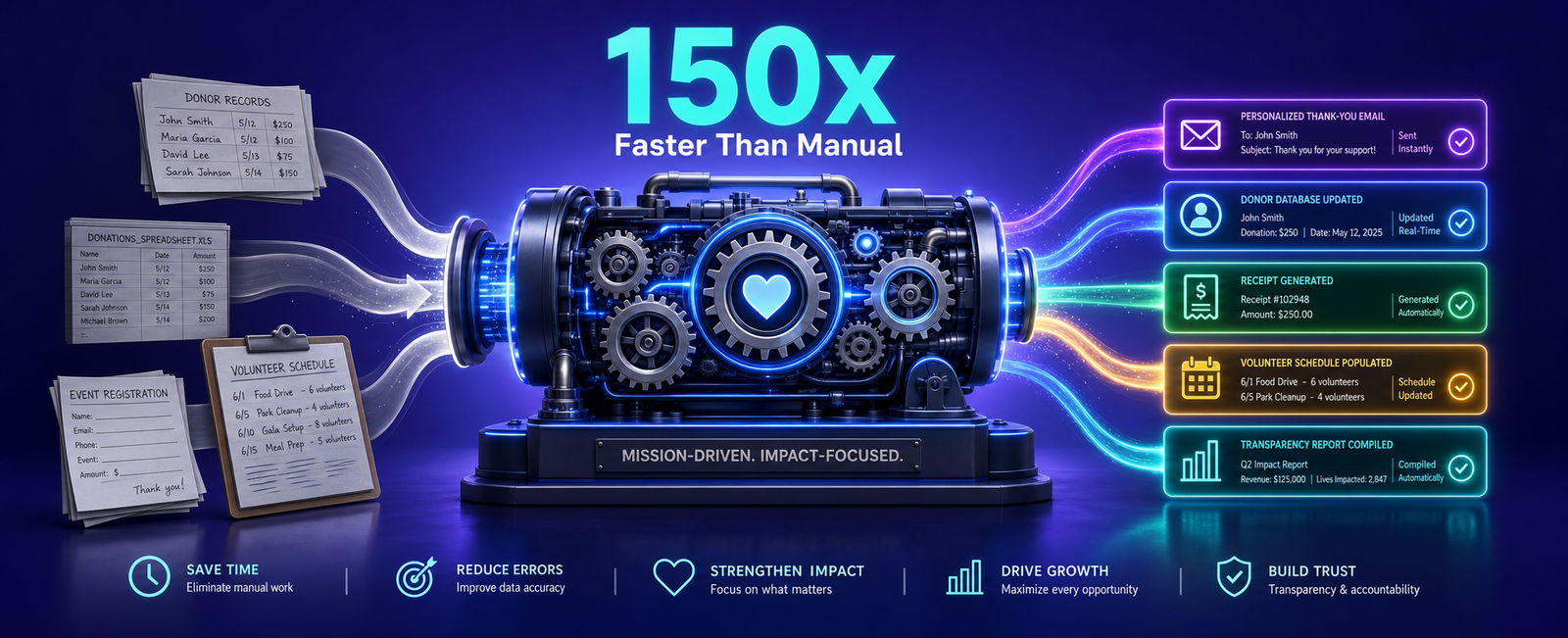
Instead of relying on manual data entry or disconnected tools, nonprofits can integrate their systems and automate routine workflows. In one study, automated workflows completed tasks over 150 times faster than manual processes.
For instance, when a donor contributes online, an automated system instantly sends a thank-you email, updates the donor database, and generates a receipt. This ensures a professional and timely response. Meanwhile, if you ask an individual to do it, they may take hours to do it for you.
Besides that, automation leaves no chance of human error. Inaccurate data or missed communications can harm donor trust. By automating these processes, nonprofits can maintain consistency and reliability in their operations.
3. Reducing Operational Burden
Automation connects various aspects of charity operations into a unified system. It simplifies daily tasks and reduces the strain on teams. For instance, Volunteer management becomes easier with automated scheduling and reminders. Event planning improves with streamlined registration and confirmation processes. Financial tracking becomes more reliable with better analytics.
According to a report by Salesforce.org, 76% of nonprofits say technology helps them better achieve their mission. So don’t underutilize automation tools. When your systems are optimized, your team will have enough time to focus on strategic initiatives. This approach allows for exponential impact through linear effort.
4. Long-Term Donor Connections
Don’t view donors as transactional funders; consider them equal partners in your mission, since your survival depends on them. Maintaining consistent communication with them will require the right set of automation tools.
Automation of email campaigns, personalized messages, and timely updates will make donors feel informed and valued. When they learn how their contributions are changing human lives, they become even more thrilled to continue being part of you and supporting your cause. Moreover, with Automation, you easily segment your audience.
5. Doing More With Less
Time is the lifeblood of your charity organization. If you also want your team to significantly reduce time on repetitive tasks, go for automation at any cost. In this way, you will save both time and resources.
You also don’t have to hire additional staff to manage growing workloads. This allows them to allocate resources more strategically toward programs and initiatives that directly support their mission.
6. Automation as a Growth Engine
Growth is a goal for many nonprofits, but scaling operations without proper systems can lead to chaos. Automation provides the foundation needed for sustainable growth.
As the organization expands, automated systems can handle increased workloads without compromising quality. Whether it is managing more donors, organizing larger events, or running multiple campaigns, automation ensures that processes remain efficient and manageable.
This scalability empowers nonprofits to broaden their reach and amplify their impact without being held back by operational limitations.
7. Showcasing Accountability
Transparency is critical for building trust with donors, stakeholders, and the community. According to Charity Navigator, transparency is one of the top factors influencing donor trust and giving behavior. With automation, non-profits enhance accountability with accurate records and detailed reports.
Moreover, it becomes easy to monitor donations, expenses, and program outcomes. This data can be shared with stakeholders to demonstrate impact and ensure compliance with regulations.
Remember that transparent reporting not only bolsters organizational integrity but also guarantees regulatory conformance, showcasing a commitment to accountability and performance
Wrapping Up
Automating operations enables charities to amplify their impact without increasing staffing, maximizing resources for those they serve. With Salesforce automation, nonprofits handle growing workloads, personalize donor interactions, and make data-driven decisions that strengthen their impact.
However, achieving the full benefits of automation requires expertise. A DIY approach often leads to automation debt, where poorly configured triggers create more confusion than they solve.
To avoid this, securing expert Salesforce Nonprofit Cloud implementation is crucial to ensure your automation strategy is sustainable and effective. Ready to revolutionize your impact? Start small, seek expert guidance, and watch your organization’s efficiency soar.