
You didn’t start your nonprofit to manage spreadsheets. You started it to change lives, protect communities, advocate for a cause, or solve a real-world problem.
In many organizations, fragmented legacy systems and manual data silos create significant operational friction, preventing leadership from achieving a unified view of impact.
This scenario is all too common for nonprofits. With Salesforce nonprofit cloud consulting, they will optimise donor engagement and accelerate growth effortlessly.
Remember that a rushed or poorly planned implementation can lead to confusion, low adoption, and wasted investment.
On the other hand, a strategic rollout can streamline operations, strengthen donor relationships, and help your team focus on what truly matters.
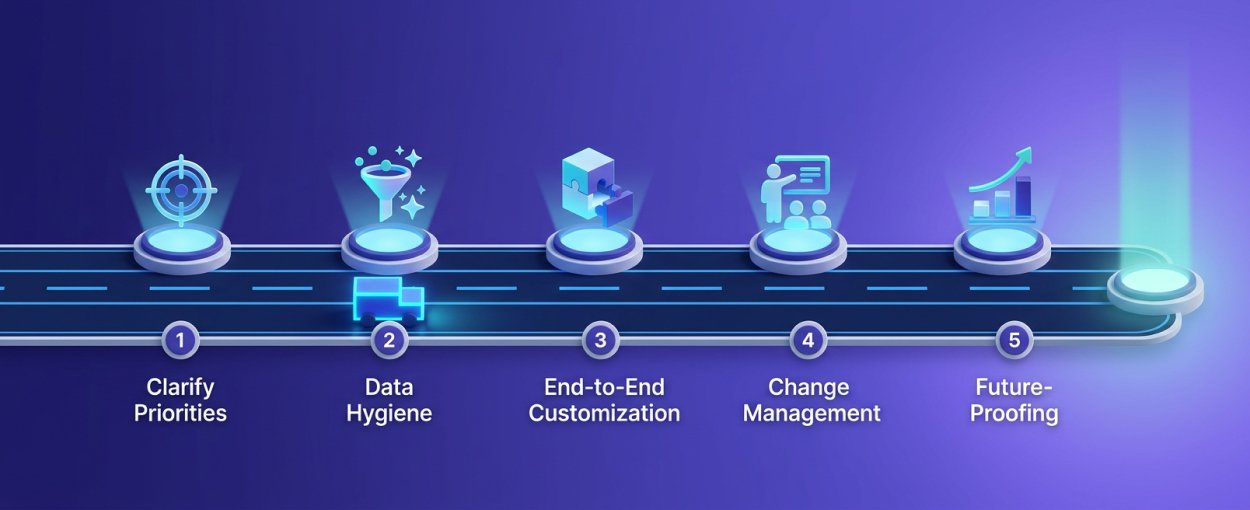
To ensure a high ROI on your Salesforce investment, implementation must be treated as a strategic digital transformation rather than a simple IT project. Here are five foundational considerations for a successful rollout.
While the allure of Agentforce AI capabilities and real-time AI insights is high, successful implementations are human-centric. Technology should be mapped to specific organizational KPIs rather than implemented for its own sake. You should first understand the problem you are trying to solve.
In this way, nonprofits will ensure that Salesforce implementation supports their mission rather than distracts from it. For more clarity, here are a few things you should miss out:
When you lead with strategy, your Salesforce rollout supports real growth instead of adding complexity.
The success of your nonprofit CRM deployment relies on cleaning up fragmented, legacy data. Data migration is the highest-risk phase of any implementation. Migrating poor-quality legacy data into a modern architecture compromises the integrity of your global reporting and prevents AI models from generating accurate insights.
Studies show poor-quality data costs organisations up to 30% of their potential revenue. This is why verifying and cleansing data is essential to eliminate ROT (Redundant, Obsolete, Trivial) content.
Establishing a robust Data Governance Framework is essential. This includes executing a ‘Data Audit’ to identify and purge ROT (Redundant, Obsolete, and Trivial) records before they enter the production environment. For instance, if you haven’t engaged a donor since 2012, do you want the system to take up space for this or not?
Salesforce’s strength is its infinite flexibility, but without guardrails, that freedom leads to a high technical debt.
We recommend considering a staggered Salesforce rollout over building everything at the same time. You should break down the project to celebrate ‘small wins amd builds collective confidence.
Following that approach, your CRM leads to higher adoption, which many nonprofits struggle with when they do overengineer.
System failure is rarely technical; it is almost always a failure of Change Management. Without a structured user enablement strategy, organizations risk the ‘spreadsheet fallback’, where staff bypasses the CRM for familiar, manual tools. Nonprofits that invest heavily in software and then assume the team will figure out its use might not work.
You necessarily have to train users to use it effectively. In fact, a recent study found that user education leads to 40% higher adoption. Moreover, research indicates that organizations with formal Change Management programs are six times more likely to meet or exceed their project objectives.
Your nonprofit CRM implementation should include role-based training sessions, process walkthroughs, ongoing support, and additional resources as needed.
Do consider that your development team, program managers, finance officers, and volunteers all have different ways of handling data. If they fail at adoption, it inevitably leads back to parallel spreadsheet systems.
Think beyond your current scale and create a system built for future growth. You must actively enforce standardised naming conventions, replacing vague titles with clear, organisational prefixes. It ensures that your data remains searchable as your team doubles or triples in size.
Instead of building rigid, one-off visuals, create flexible dashboards that use filters by year or location, allowing you to pivot instantly when you launch new branches or major recurring donation campaigns.
Architect for scalability by utilizing salesforce Data Cloud to centralize constituent signals. By building on the Core Industry Cloud model (NPC), you ensure your system is ‘Agent-ready’, capable of supporting autonomous agents as your operational complexity grows.
It will transform your Salesforce implementation into a springboard for innovation rather than a burden of technical debt that stalls your future mission.
By focusing on your people, cleaning your data, pacing your rollout, and planning for the long haul, you will definitely end up with a worthy Salesforce implementation.
When executed with intention, Salesforce rollout completely enhances how the team collaborates, communicates, and makes decisions. True nonprofit technology adoption happens when your team understands the value of the system and feels confident using it.
Salesforce implementation is an iterative journey, not a singular event. To navigate the complexities of data migration and system architecture, partnering with a certified Salesforce implementation expert ensures your organization avoids costly technical debt.
With professional support, your Salesforce rollout becomes smoother, faster, and far less stressful.