

It’s 10:00 PM on a Tuesday. Your donor relations manager is asleep, your office is dark, and your website is quiet. Suddenly, a high-capacity donor from across the globe lands on your page, inspired by a late-night news story.
They might have to send an email and wait 48 hours for a reply. However, in 2026, that’s no longer the case. Within a few seconds, your Salesforce Nonprofit Cloud agent, powered by Agentforce, will greet them and secure a major gift through an automated, secure gift-entry flow.
By the next working day, when your team logs in, the donor has already received a personalized thank-you video and been tagged for a follow-up coffee.
The defining difference between nonprofits that survive and nonprofits that scale will be how they leverage Salesforce.
In this guide, we will break down the essential Salesforce strategies nonprofits need to master. And how it can deepen donor relationships and build a more resilient, data-driven organization.
The mission of your non-profit is still the same, but the way it operates has transformed dramatically. Everything from digital campaigns to volunteers to program outcomes is increasingly difficult to manage without a unified data strategy. Moreover, it is hardly doable for those with limited staff and tight budgets.
In fact, 76% of nonprofits cite technology as a critical driver for mission scaling and operational efficiency. To stay organized, responsive, and effective, you need systems that centralize information to keep up with modern work. That’s what makes Salesforce a powerful solution for charities of all sizes.
Below are several other reasons why Salesforce is non-negotiable:
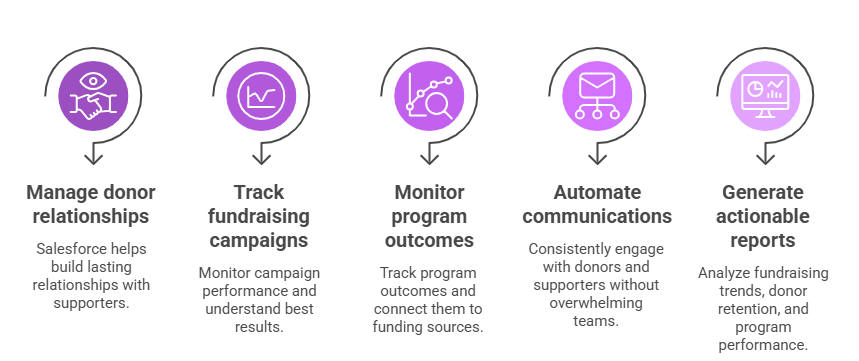
Together, these capabilities help nonprofits operate more efficiently and make smarter decisions. If you are a charity organization looking to expand your reach and mission, Providus salesforce nonprofit cloud consulting is a way forward.
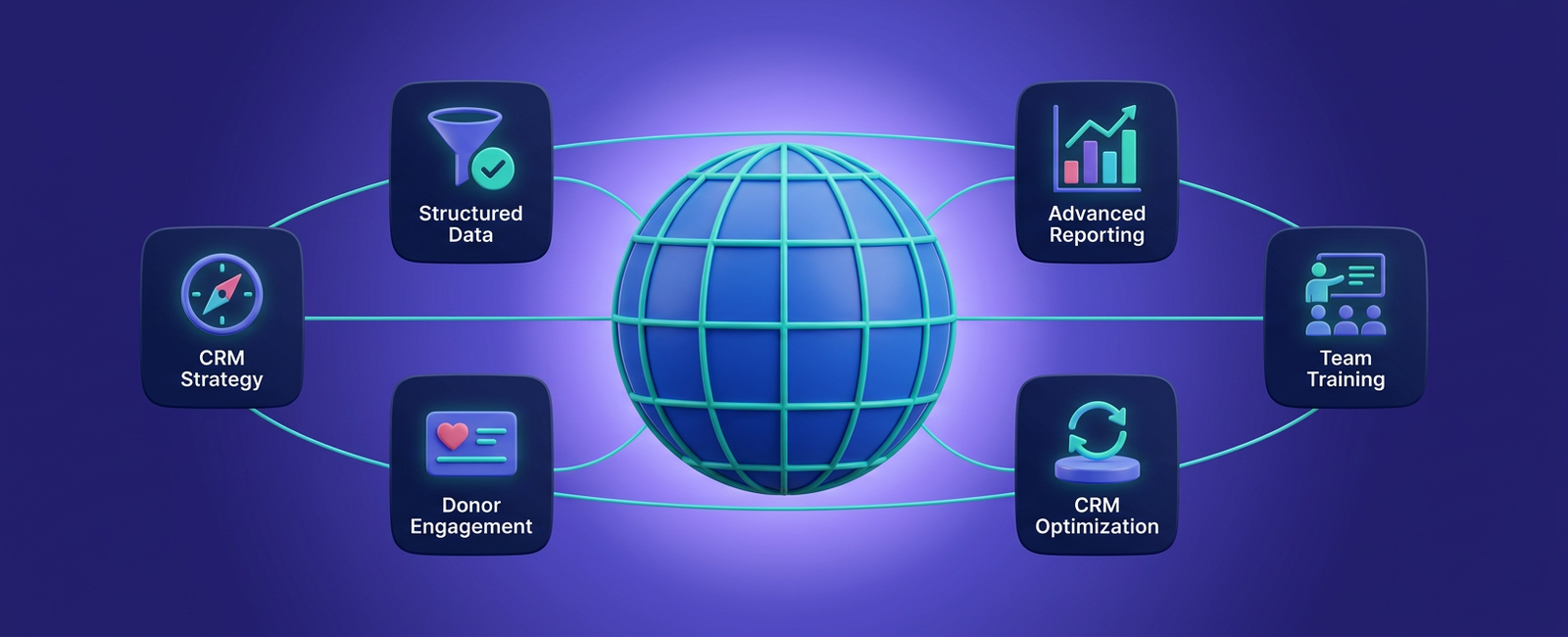
The most important yet effective CRM strategies your nonprofits should adopt are to align priorities with your goals. Too often, nonprofits deploy Salesforce without defining what success actually looks like. When they align Salesforce with measurable objectives, the system will function as a strategic asset. Moreover, with clear planning, you will ensure that every customization, workflow, and report is up to the mark.
Data quality is a significant impediment for nonprofits using CRM systems. Duplicate records, incomplete donor profiles, and inconsistent data entry can make it unreliable. Those who follow proper nonprofit CRM tips for data management will leave no chance of error. Some of the best practices for data maintenance include regularly running duplicate checks using validation rules and scheduling periodic data audits.
Nonprofits often operate with limited staff, making efficiency essential. Salesforce automation can handle many repetitive tasks that typically consume valuable time. You will send acknowledgment emails, update campaign hierarchies, and streamline journeys. The role of automation here is too vast. Besides ease, it allows you to focus more on mission-driven work.
Generic outreach is no longer a feasible option since donors want you to have meaningful communication. Salesforce, based on donor history, interests, and engagement patterns, enables nonprofits make the most impact. By not being frivolous, they strengthen relationships and increase the likelihood of recurring donations. These personalized interactions statistically will double your retention chances.
Modern charities rely heavily on data to guide their decisions. Salesforce, in that case, offers useful analytics to let you understand what is truly happening across its operations. Rather than guessing about which campaigns perform well, you analyze real metrics and identify patterns that influence donor behavior. As one of the Salesforce best practices 2026, insights through it will let your leadership see the areas of impact and improvements.
They end up with the rightful allocation of resources and decisions that work flawlessly for the actual mission.
Even a sophisticated CRM like Salesforce can fall short if teams lack the knowledge or confidence to use its features properly. Nonprofits should therefore invest in regular training to ensure staff members understand how the system supports their daily responsibilities. Organizations can provide structured onboarding for new employees, conduct refresher workshops for existing teams, and maintain clear documentation for internal processes.
Consistent training encourages employees to adopt new tools, follow standardized data practices, and use advanced features with confidence.
As nonprofits expand their programs and outreach efforts, their operational needs evolve as well. New campaign strategies emerge, reporting requirements grow, and technologies continue to develop. For this reason, nonprofits must approach CRM management as an ongoing process. Continuous Salesforce optimization ensures that the platform remains aligned with the exact mission. Those who continuously refine these areas will remain relevant with emerging nonprofit technology trends.
Salesforce gives nonprofits the technical architecture to manage donor relationships, track donor engagement, and measure results far better than traditional systems.
However, the real payoff comes from intelligent deployment, not simple adoption. When you implement these Salesforce best practices, your mission scales effortlessly.
This adoption will ultimately help charities reduce administrative friction and focus on their core goals. Yet, you should know effective Salesforce optimization requires tech expertise.
While out-of-the-box features are powerful, reaching full ROI often requires a mix of certified Salesforce consultants and trained internal staff offering Salesforce consulting services.
With the right expertise in place, nonprofits can avoid common pitfalls and build a system that truly supports long-term growth.
When strategy, technology, and expertise align, Salesforce transforms from a simple platform into a powerful engine for nonprofit impact.
To maximize the full potential of your CRM and scale your mission effectively, partner with Providus today.