Have you ever opened your donor database and felt completely overwhelmed? Like all the information is there, but somehow, you still don’t have clarity? You’re not alone.
In 2026, the challenge nonprofits face isn’t just ‘messy data’, it’s fragmented intelligence. When your donation platform, email marketing, and volunteer logs exist in silos, you lose the ability to act in the ‘mission moment.’ Mastering Salesforce today means moving from a passive database to an agentic enterprise where your CRM anticipates your next move.
That’s where Salesforce can change everything. Unlike traditional software, it does more than just save names and numbers. You connect fundraising, programs, volunteers, finance, and reporting under a single digital roof.
But Salesforce nonprofit implementation requires deliberate practice and strategic effort. It takes the right tools, a clear strategy, and smart execution.
Our team of Salesforce nonprofit consultants have prepared a detailed guide, outlining how to master and optimize your CRM for your nonprofit initiatives and mission.
Running a nonprofit strategically involves coordination, communication, accountability, and impact. Every donation needs tracking. Every volunteer needs direction. Every grant requires documentation.
Yet many nonprofits still rely on scattered spreadsheets, disconnected apps, and manual processes to manage it all. As a result, they waste time, miss opportunities, and cause unnecessary stress.
Here, Salesforce, when used strategically, provides end-to-end insights into what’s working and what needs attention. Below are several other reasons why Salesforce is a giant leap for nonprofits:
Instead of scattered tools, nonprofits enjoy a structured system that supports your mission from fundraising to reporting. Everything works together.
Before you dive into the “how,” you need to know which “what” you’re using. Salesforce currently offers two main paths for organizations:
For organizations starting fresh in 2026, the strategic choice is Salesforce Nonprofit Cloud (now Agentforce Nonprofit). As of the Spring ’26 release, this platform is the exclusive home for autonomous AI innovation, including Donor Support Agents and real-time Data Cloud triggers that NPSP cannot natively support.
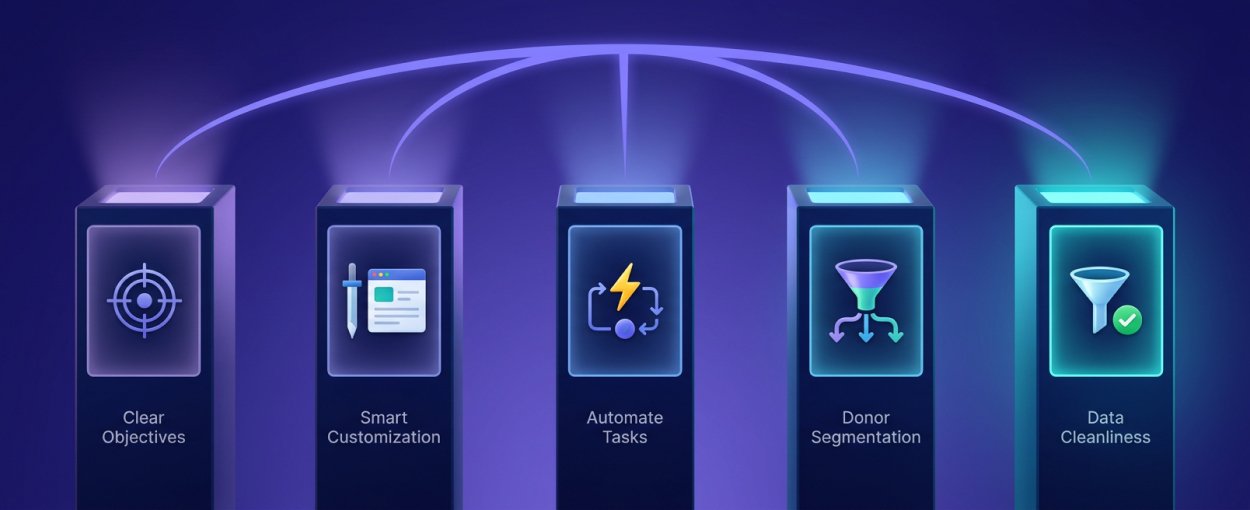
Having tools is one thing. Using them strategically is another. The difference between an average organization and a high-performing one often comes down to strategy, discipline, and smart execution. See five Salesforce tactics to consistently drive your organization’s growth:
What most non-profits do wrong is that they start straight with technicalities. But the best practice is to start by defining the purpose you want Salesforce to serve. Then ask what reports your leadership team needs to make confident decisions.
Having clear objectives ensures that every configuration supports a purpose. Simply put, strategy first, technology second. In this way, you avoid the risk of building a system that looks worse and lacks real value.
Salesforce offers deep customization options. While that flexibility is powerful, it can also become overwhelming. Many nonprofits fall into the trap of overbuilding their system with excessive custom fields, complicated workflows, and unnecessary automation rules.
Instead, create only the fields your team actively uses. Keep workflows clean and easy to follow. Standardize naming conventions so everyone understands the system without confusion. When your staff members find the CRM intuitive, they use it consistently.
Nonprofit teams already operate with limited time and resources. Manually sending donation receipts, welcome emails, and other ritual tasks drains energy.
In 2026, automation has evolved from simple ‘workflow alerts’ to Autonomous Stewardship. Use Agentforce to deploy 24/7 Donor Support Agents.
These AI agents handle recurring gift updates and tax receipt requests via natural language, allowing your team to focus exclusively on high-touch major donor engagement. More than that, welcome email sequences nurture new donors without requiring manual follow-ups.
Every hectic part of your team will be automated so that they quietly focus on higher-impact work in the background. They get an ample amount of time to engage meaningfully with donors, partners, and beneficiaries.
Not all donors are the same, so your outreach shouldn’t be either. Utilize Data Cloud for ‘Unified Constituent Scoring.’ Instead of simple manual lists, segment donors based on real-time engagement signals across your website and social platforms.
This allows for hyper-personalized ‘moment-of-impact’ communications that drive significantly higher conversion rates.
For instance, recurring donors may receive exclusive impact updates, while event attendees might receive early invitations for upcoming campaigns.
Even the most advanced CRM system fails if the data inside it is messy or inaccurate. Here, your growth depends on trust in your numbers that rely on clean data.
Make regular data audits part of your operational routine and set up duplicate management rules to prevent record duplication.
Moreover, you can establish standardized data entry protocols, so your team records information consistently.
Through this means, your leadership will rely on actual data instead of second-guessing to run the organization with clarity.
Even with the best intentions and the shiniest tools, it’s easy to hit a wall if you aren’t careful. Salesforce is a powerhouse, but it’s also sensitive to how you treat it.
If you want to keep your system humming, watch out for these common traps that trip up even the most seasoned nonprofit leaders.
Don’t let manual processes and scattered data slow down your mission. Invest in mastering Salesforce, follow best practices, and work with experts who understand both the platform and its needs.
Nonprofits that implement the right Salesforce tools for nonprofits, leverage nonprofit CRM features effectively, and apply strategic tactics are destined to succeed. Strategic Salesforce mastery ensures your CRM is an accelerator for your mission, not a hurdle for your staff. By architecting for the ‘Agentic era’ today, you ensure your nonprofit remains resilient and responsive for years to come.
However, achieving this level of excellence demands strategy, customization, and ongoing optimization. There might be certain technical areas where you struggle without guidance.
That’s what makes it paramount to hire experienced Salesforce consultants. They have deep end-to-end knowledge of nonprofit processes, proven tactics, and the ability to tweak them for your needs.